









Tick the items and set quantities. They are added to your message automatically.
Fill in your details and we will get back to you.



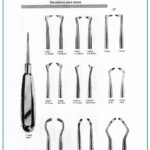
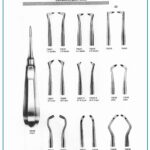
Standard surgical extraction technique requires reaching apical fragments through a narrow socket; Apical 301 to 304 gouge blades, straight and contra-angle, enter that space with a slim profile.
Consistent with fragment retrieval and root luxation technique, this range covers nineteen elevators in Apical, Seldin, Cryer and Flohr forms plus the Crane pick, all on an ergonomic thumb-rest handle.
| Instrument | Primary Use and Procedure | Design |
|---|---|---|
| Apical 301 Root Elevator | Reaches a root tip fragment in a straight line of access, the narrow blade entering beside the root | Straight narrow gouge blade, ergonomic faceted thumb-rest pear-shaped handle |
| Apical 302 Root Elevator | Reaches apical fragments in angled posterior sockets, the double curve placing the blade beside the root | Contra-angle double-curved narrow gouge blade, pair with 303 |
| Apical 303 Root Elevator | Reaches apical fragments in angled sockets on the opposite hand, the curve placing the blade by the root | Contra-angle double-curved narrow gouge blade, pair with 302 |
| Apical 304 Root Elevator | Lifts a root tip fragment with a blade a little wider than the 301, the rounded tip protecting the socket wall | Straight medium-narrow gouge blade, rounded tip |
| 12 A Root Elevator | Starts luxation of a very slim root in a tight socket, the micro blade slipping into the ligament space | Straight extra-narrow micro gouge blade |
| 34 S Seldin Root Elevator | Loosens a slim root by working the small blade between the root surface and the alveolar wall | Straight slender small gouge blade, rounded tip |
| 34 Seldin Root Elevator | Loosens a broader root by working the wider blade between the root surface and the alveolar wall | Straight medium-wide gouge blade, rounded tip |
| Root Elevator (Straight) | Enters a tight ligament space to begin luxation of a single root, the slender blade following the root | Straight slender narrow gouge blade |
| Flohr Root Elevator (Straight) | Shifts a small root or remnant by lever action, the long narrow blade entering the ligament space | Straight narrow elongated gouge blade |
| Flohr Root Elevator (Curved Left) | Reaches posterior roots where a straight shank restricts access, the curve clearing adjacent teeth | Contra-angle double-curved narrow gouge blade, left/right pair |
| Flohr Root Elevator (Curved Right) | Reaches opposite-hand posterior roots where a straight shank limits access, the curve clearing teeth | Contra-angle double-curved narrow gouge blade, left/right pair |
| 3 Seldin Root Elevator | Luxates a wide root by lever action against the alveolar wall, the broad blade spreading the force | Straight wide gouge blade, rounded tip |
| Root Elevator (Straight Flat/Gouge) | Seats a shallow blade on the root surface to begin luxation, the flat form sitting close to the root | Straight narrow flat shallow-gouge blade |
| 3 A Cryer Root Elevator | Loosens a root of medium width by cutting the ligament fibres, the chisel edge entering the ligament space | Straight narrow chisel gouge blade |
| 2 Seldin Root Elevator | Wedges a tapered blade into the ligament space to open a socket for a larger root before luxation | Straight spear spatula-shaped tapered blade |
| 12 Cryer Root Elevator | Engages a molar root after septal bone removal, the pointed blade biting into the root surface to rotate it | Straight diamond lance-shaped sharp pointed blade |
| 5 Seldin Root Elevator | Picks root tips and fragments from the socket, the angled point catching the broken surface | Slightly curved angled sharp pointed blade |
| Crane Pick Root Elevator | Lifts a broken root tip from the socket by pick action, the angled point catching the fracture surface | Sharp angled root-tip pick blade |
| Root Elevator (T-Shaped / Bifurcated) | Engages a wide root surface with the flared concave tip, which cradles the root during luxation | Wide flared winged concave T-tip blade |
Apical 301 and 304 straight blades suit a tip in a straight line of access, and the 302 and 303 contra-angle pair reaches angled posterior sockets on the left and right.
Seldin 34 S, 34, 3, 2 and 5, Cryer 3 A and 12, and Flohr in straight, curved left and curved right, plus a Crane pick and a T-shaped blade.
Tick both the 302 and the 303, set a quantity for each and submit the quote form.