



Hemostatic forceps lock across a bleeding vessel so the surgeon can ligate it with both hands free. Consistent with laparotomy technique, small vessels call for fine mosquito forceps and larger vessels for Kelly or Rochester-Pean jaws. Straight and curved patterns run from 3½″ Hartman to 12″ Rochester-Pean.
Halstead and Hartman tips control small vessels in laparotomy, and the Jacobson micro mosquito forceps add extremely delicate jaws for the finest work. Kelly, Crile and Rankin-Crile patterns suit medium vessels, while Rochester-Pean and Rochester-Carmalt forceps reach 12″ for larger pedicles. Kocher and Rochester-Ochsner add 1×2 teeth, and Schnidt and Sawtell tonsil patterns serve tonsillectomy.
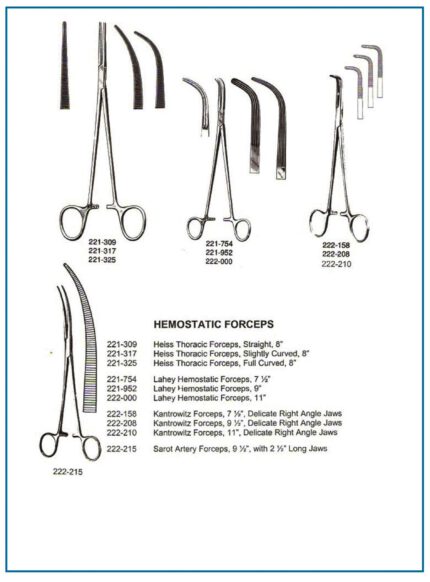
Right angle jaws pass behind a vessel or duct so a ligature can follow. Mixter patterns run from 6¼″ to 11″, Sarot artery forceps carry 2½″ jaws, and Adson patterns add straight and curved 7″ forceps. For cholecystectomy, Moynihan, John Hopkins, Green and Gray cystic duct forceps clamp the duct, while Lahey, Kantrowitz and Heiss forceps extend to 11″.
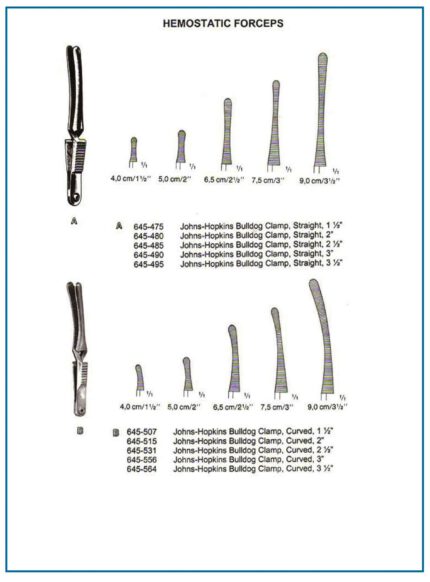
For temporary vessel occlusion during vascular anastomosis, Johns-Hopkins bulldog clamps come straight and curved in five lengths from 1½″ to 3½″, and Dieffenbach serrefines add 1½″ and 2¼″ sizes. Bainbridge and Ferguson angiotribe forceps clamp vessels ahead of ligation in straight and curved patterns, while Jacobs vulsellum forceps add serrated 2×2 teeth at 8½″.
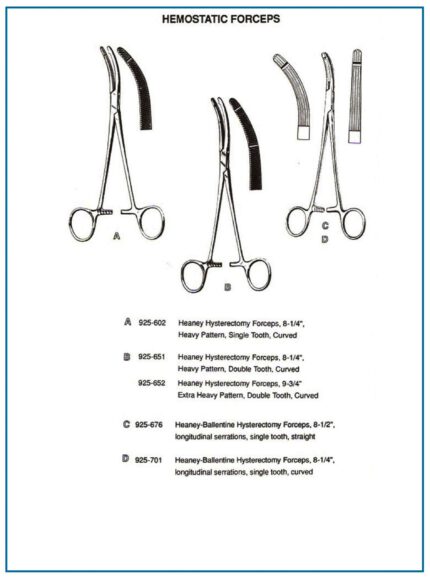
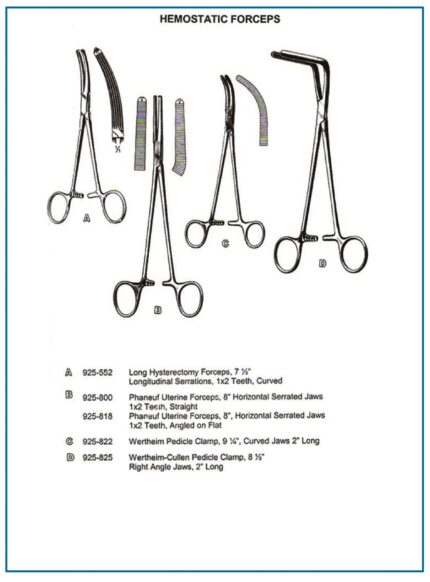
Each uterine pedicle is clamped before it is cut and tied in hysterectomy. Heaney heavy and extra heavy forceps run 8¼″ to 9¾″ with single or double teeth, and Heaney Ballentine forceps add longitudinal serrations. Wertheim and Phaneuf forceps bring curved and right angle jaws 2″ long, plus 8″ uterine forceps and a 7½″ long hysterectomy forceps for ligament tissue.
| Pattern family | Procedure and use |
|---|---|
| Mosquito, Kelly and Rochester patterns | Clamps small to large vessels in laparotomy, with Sawtell tonsil patterns for tonsillectomy |
| Mixter, Lahey and duct forceps | Passes ligatures behind vessels and clamps cystic ducts in cholecystectomy |
| Bulldog, Bainbridge and angiotribe clamps | Occludes vessels temporarily in vascular anastomosis and clamps vessels ahead of ligation |
| Heaney and Wertheim clamps | Holds each uterine pedicle before it is cut and tied in hysterectomy |
Heaney heavy and extra heavy forceps hold thick uterine pedicles in 8¼″ to 9¾″ lengths. Wertheim and Wertheim-Cullen clamps add 2″ jaws in curved and right angle form.
Kelly forceps are the mid-size pattern, supplied at 5½″ in straight and curved. Rochester-Pean forceps are the heavier pattern for larger vessels, running 5½″ to 12″ in straight and curved.
Yes. They are surgical grade stainless steel and reusable. Reprocessing guidelines call for leaving the ratchet open during cleaning and sterilisation, so every jaw and joint surface is reached.
Surgeons who need tissue handling rather than vessel clamping can turn to atraumatic forceps, pelvic teams can add gynecological instruments, and theatres restocking regularly can choose forceps in ready packs.