
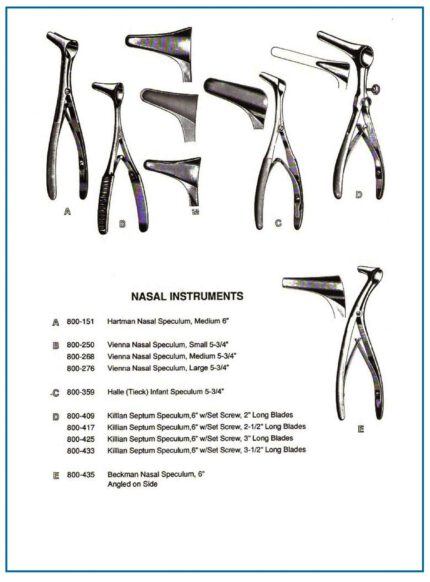


Standard ENT protocol requires a speculum that holds the nostril open while both hands work on the septum. These nasal instruments start with Hartman, Vienna, Killian and Beckman speculums, including Killian septum speculums with a set screw and blade lengths from 2 to 3-1/2 inches.
Instrument geometry designed for mucosa, cartilage and nasal bone separates this range into four groups: speculums, nasal forceps, septum cutting and straightening forceps with snares, and elevators. Together they cover 28 items for rhinoplasty, septoplasty and polyp removal.
Vienna nasal speculums come in small, medium and large 5-3/4″ sizes for nasal examination, and the Halle (Tieck) infant speculum serves pediatric examination. The Hartman 6″ medium and the Beckman 6″ speculum, angled on the side, cover nasal and sinus examination. For septum procedures, Killian speculums lock with a set screw at 2, 2-1/2, 3 and 3-1/2″ blade lengths.
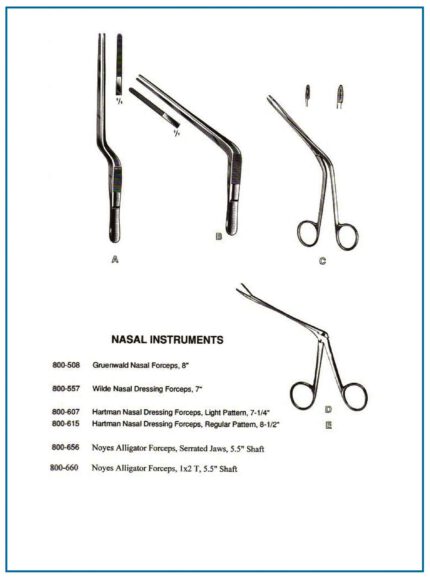
Gruenwald and Noyes forceps handle precise grasping in the nose. The Gruenwald is 8″ with a curved tip, and the Noyes alligator has a 5.5″ shaft with serrated jaws or 1x2 teeth for a firmer hold. Wilde dressing forceps at 7″ and Hartman dressing forceps in light 7-1/4″ and regular 8-1/2″ patterns place nasal dressings with serrated grips.
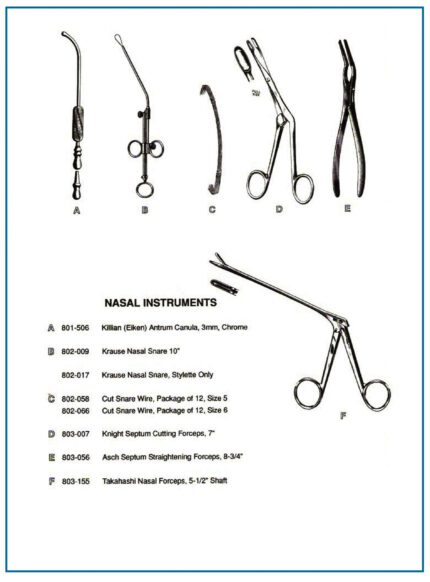
Takahashi and Asch forceps lead this group: the Takahashi has a 5-1/2″ shaft for tissue grasping and removal, and the Asch straightens the septum at 8-3/4″. Knight septum cutting forceps at 7″ trim nasal cartilage. The Krause nasal snare at 10″ serves polyp removal with cut snare wire in packs of 12, sizes 5 and 6, and the 3 mm Killian (Eiken) antrum canula serves antrum procedures.
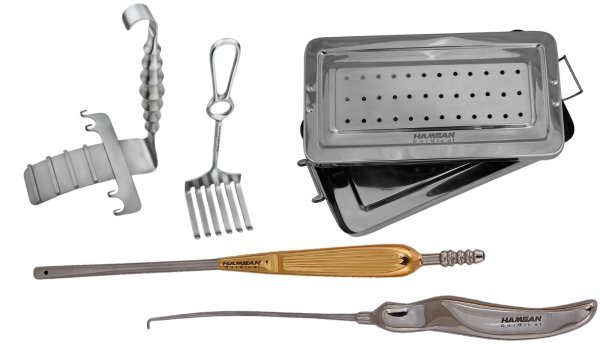
The Freer septum elevator is double-ended, sharp and blunt, at 7-1/2″ for septal dissection and elevation in rhinoplasty and septoplasty. Ballenger swivel knives at 7-3/4″ come with 3 mm, 4 mm and 5 mm blades for precise bone and cartilage cutting, from septoplasty to wide-area bone dissection in rhinoplasty.
| Pattern family | Procedure and use | Design and sizes |
|---|---|---|
| Hartman, Vienna, Halle, Killian and Beckman speculums | Nasal, sinus and pediatric examination, septum procedures | Vienna 5-3/4″ in three sizes; Killian set-screw blades 2″ to 3-1/2″; Beckman 6″ angled |
| Gruenwald, Wilde, Hartman and Noyes forceps | Nasal grasping and dressing placement | Gruenwald 8″ curved tip; Wilde 7″; Hartman 7-1/4″ and 8-1/2″; Noyes 5.5″ shaft, serrated or 1x2 teeth |
| Takahashi, Knight and Asch forceps, Krause snares | Polyp removal, septal cartilage trimming, septum alignment | Takahashi 5-1/2″ shaft; Knight 7″; Asch 8-3/4″; Krause snare 10″; 3 mm antrum canula |
| Freer elevator and Ballenger swivel knives | Septal dissection, bone and cartilage cutting in rhinoplasty and septoplasty | Freer double-ended, sharp and blunt, 7-1/2″; Ballenger 3, 4, 5 mm blades, 7-3/4″ |
Killian septum speculums come with a set screw and 2″, 2-1/2″, 3″ or 3-1/2″ blades. The 2″ blade positions securely, the 3″ gives wide exposure, and the 3-1/2″ gives the longest reach for deeper visibility.
The Freer elevator is double-ended, sharp and blunt, for septal dissection and elevation. The Ballenger swivel knife, in 3, 4 and 5 mm blade sizes, cuts bone and cartilage.
Open the product that holds the item, tick the items you need, set the quantity for each and submit the quote form. Speculums, forceps, snares and elevators all follow the same steps.
For adjacent work, see tonsil and adenoid instruments, nasal scissor packs and ENT surgery sets.